Proe
Power Systems, LLC
”Making Thermodynamics a Household Word” ®
Proe Afterburning™ Cycle:
a Clean, Low Cost Alternative to
Fuel Cells and
Modern Materials and Thermodynamics Applied to 19th Century Engines to Meet 21st Century Emission and Fuel Economy Requirements
 Proe
Power Systems' Proe Afterburning™ Cycle Engine builds upon technology developed
and proven by George Brayton and John Ericsson, both brilliant 19th century engineers
who successfully pioneered modern engine development (see the Brayton and Ericsson page for more
information). George Brayton provided
the engines that propelled the US Navy’s first submarine,
Proe
Power Systems' Proe Afterburning™ Cycle Engine builds upon technology developed
and proven by George Brayton and John Ericsson, both brilliant 19th century engineers
who successfully pioneered modern engine development (see the Brayton and Ericsson page for more
information). George Brayton provided
the engines that propelled the US Navy’s first submarine,
The need for low emissions and
fuel consumption has renewed interest in Brayton and Ericsson reciprocating
engines. Unlike internal combustion
engines, they have continuous and constant pressure combustion that can be made
very clean burning. Unlike turbine engines, reciprocating versions of these
engines can be made and maintained in automotive type production and
maintenance facilities; resulting in a much lower initial investment and long
term operating costs. Proe Power Systems
has taken the reciprocating Brayton and Ericsson Cycle into the 21st century
by: by utilizing 21st century heat transfer techniques; by applying
modern stainless steel materials; by developing the low-pressure, continuous,
Afterburning combustion process and by inventing the Proe 90TM recuperator.
A Breakthrough Technology:
The
patented Proe
Afterburning™ Cycle Engine effectively integrates the combustion and power
producing processes.
The resulting engine is capable of high thermodynamic efficiency with complete,
continuous, and clean combustion. It not
only works as an efficient stand-alone engine capable of efficient power
generation from gaseous, liquid and solid fuels but is uniquely qualified
for Symbiotic™ waste heat recovery – a process than not only provides
mechanical or electrical power from waste heat, but improves the efficiency and
emissions of the original combustion process itself.
Fuel Cells Aren’t the Answer: Our new innovations are a step forward in development of the Proe Afterburning™ Cycle engine as a low cost fuel cell alternative. Fuel Cells are very efficient and have no significant emissions when fueled by hydrogen gas. However, when using fuels available in today's infrastructure (gasoline, propane, LPG etc.) fuel cells not only require an expensive fuel cell stack with hydrogen, air, and water control systems but also a reformer to extract the hydrogen from the fuel. The carbon portion of the fuel cannot be used by the fuel cell stack and is wasted by being exhausted from the reformer as carbon dioxide. Proe Power Systems' Proe Afterburning™ Cycle Engine has equivalent fuel efficiency and exhaust emissions at a much lower initial cost. The engine is less complex than current automotive engines but has the patented, low pressure, continuous combustion process that produces lower emissions than any competitive power system. For comparison data, click on the Fuel Cell comparison page.
The
Proe Afterburning™ Cycle Engine also avoids the problem the Stirling Engine has
in becoming "heat bound". An open cycle, such as the Proe
Afterburning™ cycle and standard car and truck engines, receives a fresh charge
of cold air and exhausts warm air during each cycle. The temperature difference
between inlet and exhaust represents heat that, even though unavailable for
making power, must be rejected to allow the engine to continue to run. The
closed
The
New Technology Using Conventional Engine Parts: The Proe Afterburning™ Cycle Engine uses simple, conventional, engine components to provide an engine having low fuel consumption while meeting 21st century environmental requirements. Although well suited to gasoline fuel, the cycle is ideal for alternative fuels such as CNG, Propane, Wood Chips, and Hydrogen. Powerplants using this cycle will soon become viable, low-cost, alternatives to fuel cells, diesel engines and gas turbine engines.
All
components of both the Proe Afterburning™ Cycle Engine and its Proe 90TM recuperator can be manufactured
in any machine shop capable of rebuilding an automobile engine. The simple
construction allows small manufacturers to effectively enter the 21st century
power market with minimal new investment while still producing powerplants
having efficiency and emissions performance competitive with fuel cells or microturbines.
Distributed
Power Generation, Combined Heating and Power, and Village Power:
The
Proe Afterburning™ Cycle is ideally suited to Distributed Power Generation. The high efficiency, low emissions, ability
to use a wide variety of fuels and simplicity of construction will soon make it
the engine of choice for these applications. The engine's ability to directly
and cleanly combust solid fuels and cellulosic biomass without the need for
complex and costly gasification or digestion allows the engine to be directly
fueled by readily available renewable resources and is an excellent match to
Village Power requirements.
Current
Projects:
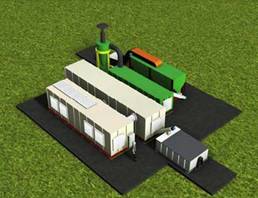 Proe
Power Systems will soon introduce the PPS
250tm solid biofuel powerplant.
This powerplant will revolutionize the biofuel power generation market
by its combination of low initial cost, efficient use of virtually unprocessed
biofuel, low maintenance, and highly reliable service. The powerplants will produce a nominal 250
kWe of electric power and approximately 450 kWt of
heating (i.e. 2000 gallons of hot water per hour) for CHP. They will also be
capable of efficient load following from 30 to 280 kWe. Look for additional information in the near
future.
Proe
Power Systems will soon introduce the PPS
250tm solid biofuel powerplant.
This powerplant will revolutionize the biofuel power generation market
by its combination of low initial cost, efficient use of virtually unprocessed
biofuel, low maintenance, and highly reliable service. The powerplants will produce a nominal 250
kWe of electric power and approximately 450 kWt of
heating (i.e. 2000 gallons of hot water per hour) for CHP. They will also be
capable of efficient load following from 30 to 280 kWe. Look for additional information in the near
future.
Further Information:
Proe
Afterburning™ Engine technology has developed from Proe Power Systems’
innovative work on the Afterburning Ericsson Cycle Engine. Significant improvements have recently been
made that resulted in the evolution from the Afterburning Ericsson cycle to the
Proe Afterburning™ cycle. An
Afterburning Ericsson Cycle Engine TechPak is listed
with yet2.com(TM), the marketplace for licensable
technologies from all over the world. (The Afterburning
Ericsson Cycle Engine was selected as a NASA Featured Technology.) Proe Power Systems presented the Afterburning
Ericsson Cycle Engine at the Society of Automotive Engineers’ 1999 Future
Transportation Technology Conference and a paper on the Proe 90tm
gas turbine recuperator was presented at the 2002 American Society of
Mechanical Engineers Turbo Expo. Additional information is available from:
Richard Proeschel, P.E.
Chairman & Program Manager
Proe Power Systems, LLC
5072 Morning
International Phone: 1-(330)723-4469 ext. 600
Fax: (330)723-4469
r.proeschel@proepowersystems.com

- Proe Afterburning(tm) Technology Brochure (Adobe pdf file)
- Proe Power Systems Introduction
- More About our Related Technologies
· Proe 90TM Gas Turbine Recuperator Page
· Proe Power Systems HRPGTM Heat Recovery Power Generator Brochure (Adobe pdf file)